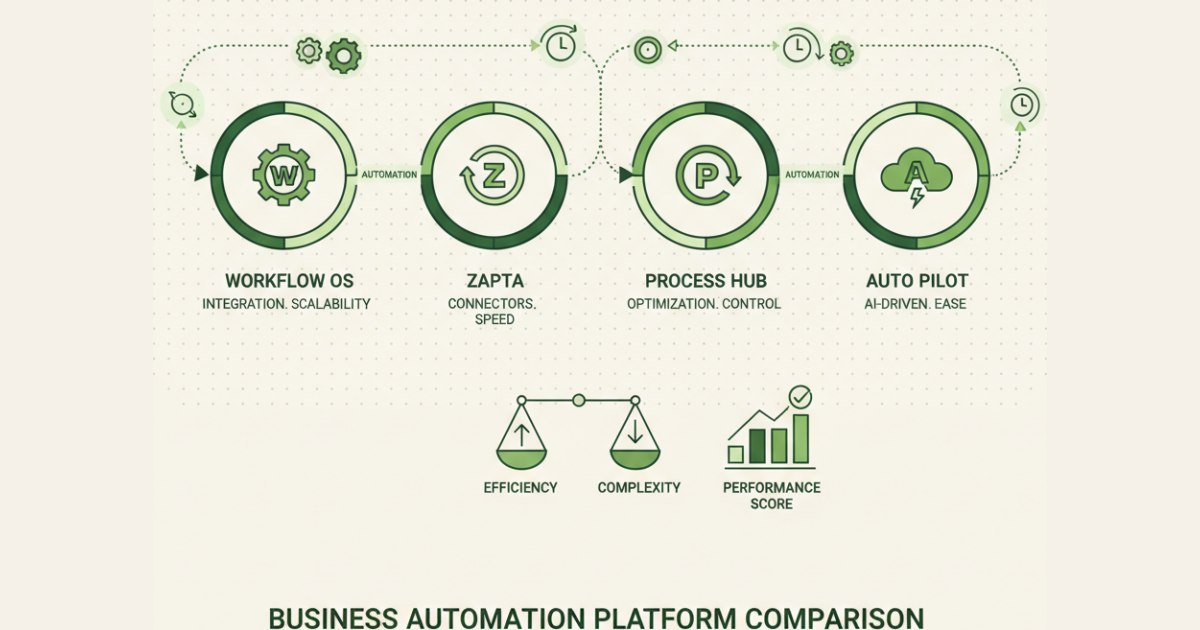
Compare the top workflow automation platforms to find the best fit for your team's needs and budget
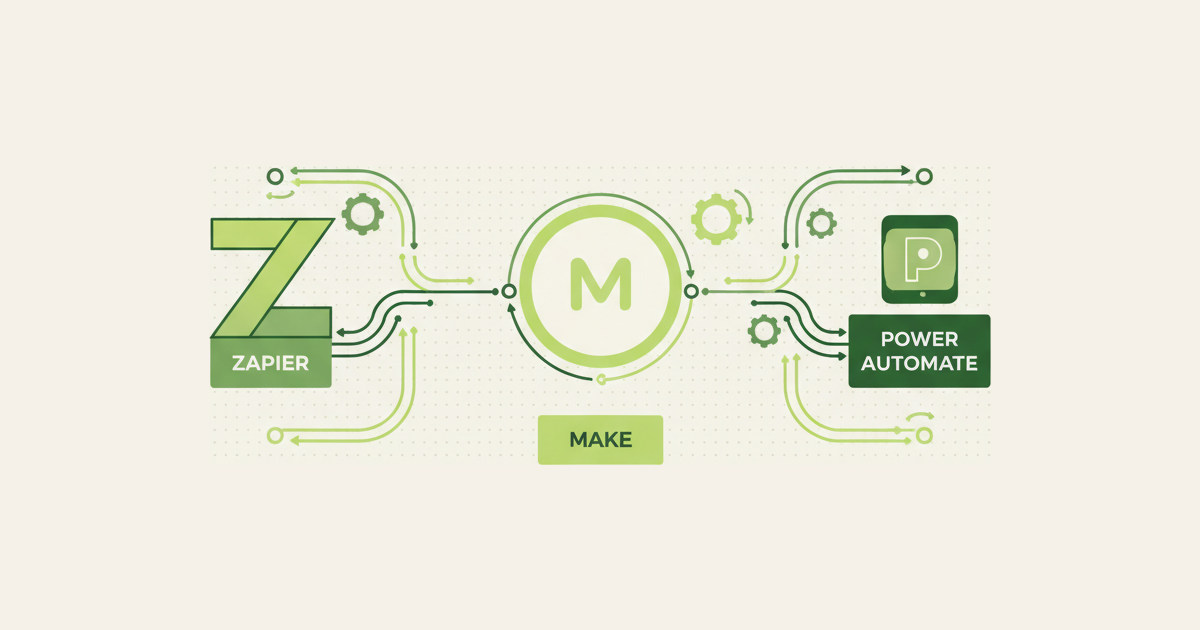
How These Platforms Differ at a Glance
| Platform | Best For | Pricing Model | AI Features | Self-Hostable |
|---|---|---|---|---|
| Zapier | Non-technical teams, quick setup | Per-task pricing ($20-$600+/month) | Basic AI actions, ChatGPT integration | No |
| Make | Visual workflow builders, complex logic | Operations-based ($9-$299/month) | AI content generation, OpenAI nodes | No |
| n8n | Developer teams, full control | Free self-hosted, $20+/month cloud | Custom AI integrations, code flexibility | Yes |
| Workato | Enterprise teams, complex integrations | Quote-based ($10K+/year) | Advanced AI/ML, intelligent automation | Enterprise only |
| Ideople | AI-first teams, SaaS companies | Transparent per-seat ($49-$199/month) | Native AI agents, smart workflow optimization | Hybrid options |
The pricing differences alone can make or break your decision. Zapier's per-task model seems affordable until you're processing thousands of operations monthly. Make's visual approach appeals to non-developers but requires more setup time. n8n offers unlimited automation but demands technical expertise.
Detailed Platform Breakdowns
Zapier: The User-Friendly Giant
Zapier dominates the automation space for good reason—it's incredibly easy to use. With over 9,000 app integrations and a point-and-click interface, non-technical teams can build workflows in minutes. The platform excels at simple trigger-action automations like "when someone fills out a form, add them to our CRM."
However, Zapier's simplicity comes with limitations. Complex conditional logic requires multiple Zaps, quickly inflating costs. Advanced features like webhooks, custom code, and data transformation exist but feel bolted-on. The per-task pricing model that starts reasonably at $20/month can explode to $600+ for growing companies.
Zapier works best for teams under 50 people who need quick wins and don't mind paying premium prices for simplicity. If you're processing under 1,000 tasks monthly and value ease-of-use over cost efficiency, Zapier remains the gold standard.
Make: The Visual Workflow Builder
Make (formerly Integromat) takes a different approach with visual workflow builders that look like flowcharts. This visual representation makes complex logic more intuitive—you can see exactly how data flows through your automation. Make also offers better value with operations-based pricing starting at $9/month.
The platform shines for teams that need sophisticated workflows but lack coding skills. Features like data transformation, error handling, and conditional branching are built-in rather than afterthoughts. Make's router and iterator functions handle complex data processing that would require multiple Zapier workflows.
The downside? Make has a steeper learning curve. The visual interface can become overwhelming with complex workflows, and the European-based company sometimes lags in adding new app integrations compared to Zapier. Make works best for teams willing to invest time upfront for better long-term value and flexibility.
n8n: The Open-Source Alternative
n8n represents the developer-friendly end of the spectrum. As an open-source platform, it offers unlimited self-hosted automation at no cost beyond infrastructure. The node-based visual editor combines ease-of-use with powerful customization through JavaScript code snippets.
For technical teams, n8n provides unmatched flexibility. Custom integrations, advanced data processing, and complete workflow control are standard. The self-hosted option means no vendor lock-in and full data control—crucial for companies with strict security requirements.
The trade-off is complexity. n8n requires technical setup, maintenance, and troubleshooting. While the cloud version ($20+/month) reduces operational overhead, you're still dealing with a more technical platform. n8n excels for developer-led teams that prioritize control and customization over plug-and-play simplicity.
Workato: The Enterprise Powerhouse
Workato targets enterprise customers with sophisticated integration needs. The platform combines workflow automation with enterprise application integration (EAI), handling complex B2B scenarios that would challenge other platforms. Advanced AI features include intelligent data mapping and predictive automation.
Workato's strength lies in handling enterprise-grade complexity—multi-step approval workflows, complex data transformations, and integration with legacy systems. The platform includes built-in governance, monitoring, and compliance features that enterprises require.
However, Workato's enterprise focus means enterprise pricing—typically $10,000+ annually with quote-based pricing. The platform assumes technical expertise and dedicated integration teams. Workato makes sense for large organizations with complex integration requirements and dedicated IT resources.
Ideople: The AI-First Platform
We built Ideople specifically for SaaS teams frustrated with traditional automation limitations. Our AI-first approach means intelligent workflow optimization, predictive automation suggestions, and native AI agents that handle complex decision-making without manual rule creation.
Unlike platforms that bolt AI features onto existing architectures, we designed every component around AI capabilities. This means smarter error handling, automatic workflow optimization, and AI agents that learn from your data patterns. Our transparent per-seat pricing ($49-$199/month) scales predictably with your team rather than punishing success with usage-based fees.
We're honest about our positioning—we're not trying to replace Zapier for simple automations or compete with n8n for maximum flexibility. Instead, we focus on AI-powered automation for growing SaaS companies that need enterprise capabilities without enterprise complexity or pricing.
When to Choose Which Platform
The right platform depends on four key factors: team size, technical ability, budget constraints, and AI requirements.
Small teams (1-10 people) with limited technical skills: Zapier provides the fastest path to automation success. Accept the higher per-task costs for speed and simplicity.
Growing teams (10-50 people) wanting better value: Make offers sophisticated workflows at reasonable prices. Invest time in learning the visual interface for long-term savings.
Technical teams prioritizing control: n8n delivers unlimited flexibility and customization. Self-host for maximum control or use cloud hosting for easier management.
Enterprise teams with complex needs: Workato handles sophisticated integration scenarios that would overwhelm other platforms. Budget accordingly for enterprise pricing.
AI-focused SaaS teams: Ideople combines enterprise AI capabilities with transparent pricing designed for scaling businesses. Best fit for teams that want AI-powered automation without the complexity.
Real Migration Stories
Case Study 1: SaaS Startup Outgrows Zapier
TechFlow, a 25-person SaaS company, started with Zapier for basic lead routing and customer onboarding. As they scaled to 5,000 monthly signups, their Zapier bill hit $800/month for increasingly complex workflows.
They migrated to Ideople over two weeks, reducing costs to $245/month while adding AI-powered lead scoring and automated customer success workflows. The AI agents now handle complex decision trees that would have required dozens of Zapier rules.
Case Study 2: Agency Switches from Make to n8n
DigitalCraft, a marketing agency, used Make for client workflow automation but hit limitations with custom integrations. Client demands for specialized connectors and data processing exceeded Make's capabilities.
They migrated to self-hosted n8n, gaining unlimited automation and custom integration capabilities. The technical investment paid off with new service offerings around custom automation development, turning their internal tool into a revenue stream.
Common Selection Mistakes
Myth: "We'll start simple and upgrade later"
Reality: Platform migrations are expensive and time-consuming. Choose based on your 12-month needs, not current requirements. Simple platforms like Zapier become cost-prohibitive at scale, while complex platforms like n8n require upfront technical investment.
Myth: "More integrations always means better"
Reality: Integration quality matters more than quantity. Zapier's 9,000 integrations include many shallow connections. Focus on deep integrations with your core tools rather than breadth of options.
Myth: "Open-source means free"
Reality: n8n's self-hosted option requires infrastructure, maintenance, and technical expertise. Factor in DevOps time, server costs, and backup systems. The "free" option often costs more than cloud alternatives when you include operational overhead.
How to Test Drive Each Platform in One Week
Here's our proven 5-step evaluation framework:
Day 1-2: Map Your Current Workflows
Document your existing automations, including triggers, actions, and data transformations. Identify your top 5 most critical workflows for testing.
Day 3-4: Build Test Workflows
Recreate your critical workflows on each platform. Focus on complexity, not just basic functionality. Test error handling, data transformation, and conditional logic.
Day 5: Evaluate AI Capabilities
Test each platform's AI features with real data. Compare intelligent routing, content generation, and predictive capabilities. [Understanding workflow automation fundamentals](https://ideople.com/blog/technology/what-is-workflow-automation-the-complete-2026-guide) helps identify where AI adds genuine value versus marketing hype.
Day 6: Calculate True Costs
Project costs at 3x, 5x, and 10x your current automation volume. Include setup time, maintenance overhead, and potential migration costs. Factor in team training and ongoing management requirements.
Day 7: Decision Framework
Use our Platform Fit Score (detailed below) to objectively compare options. Weight factors based on your priorities and make the decision based on data, not demos.
Ready to evaluate how Ideople's AI-first approach fits your automation needs? [Book a demo](https://ideople.com/demo) to see our platform in action with your specific use cases.
The Ideople Platform Fit Score Framework
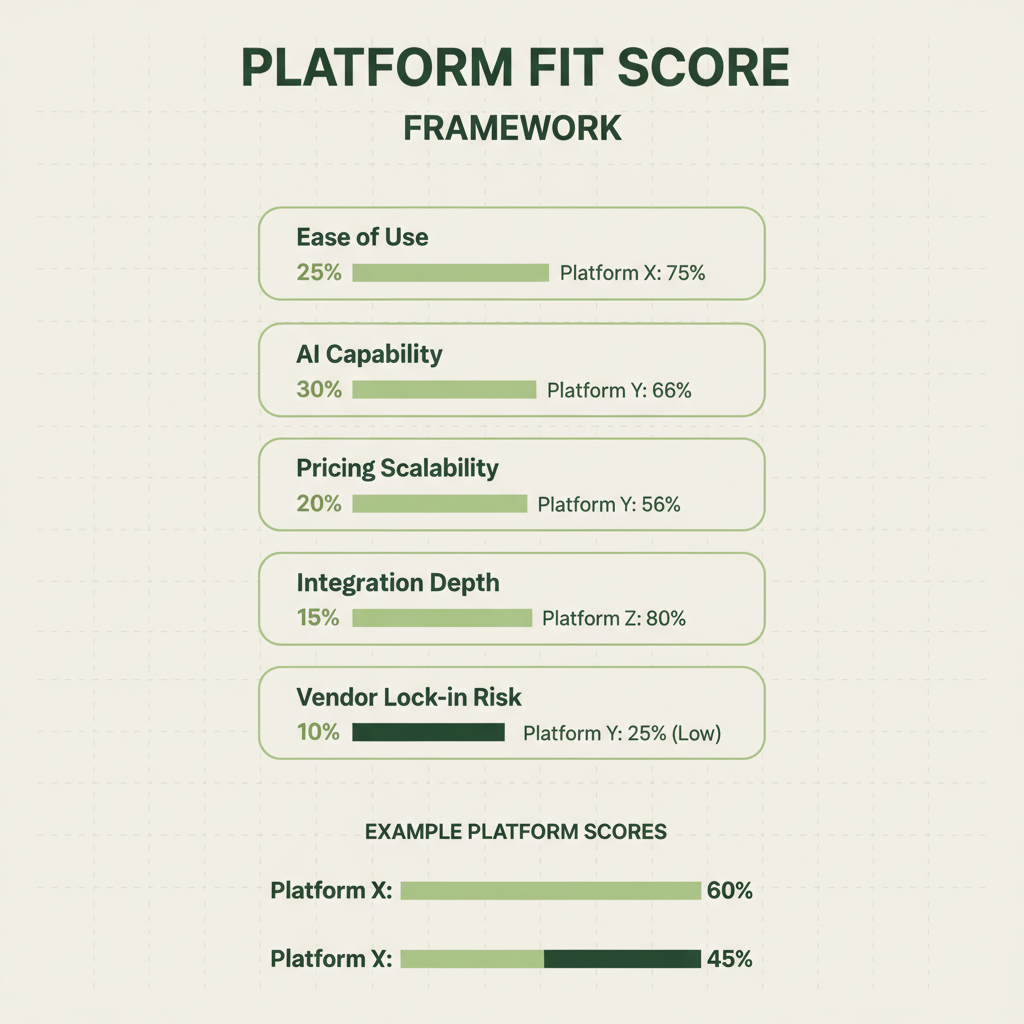
Platform Fit Score framework with weighted criteria for objective platform comparison
We developed this 5-factor weighted scorecard to help teams make objective platform decisions:
1. Ease of Use (Weight: 25%)
- Setup complexity (1-10 scale)
- Learning curve for team members
- Ongoing maintenance requirements
2. AI Capability (Weight: 30%)
- Native AI features vs. bolt-on integrations
- Intelligent automation suggestions
- Predictive capabilities and learning
3. Pricing Scalability (Weight: 20%)
- Cost predictability as usage grows
- Hidden fees and usage spikes
- Value alignment with business growth
4. Integration Depth (Weight: 15%)
- Quality of core tool connections
- Custom integration capabilities
- API flexibility and reliability
5. Vendor Lock-in Risk (Weight: 10%)
- Data export capabilities
- Workflow portability
- Platform independence
Worked Example: Mid-size SaaS Company
For a 30-person SaaS company prioritizing AI capabilities:
- Zapier: 6.2/10 (high ease of use, limited AI, expensive scaling)
- Make: 7.1/10 (good balance, moderate AI, better pricing)
- n8n: 6.8/10 (high flexibility, requires technical skills)
- Ideople: 8.4/10 (strong AI, transparent pricing, designed for SaaS)
The framework reveals that while Zapier excels in ease of use, the AI capability and pricing scalability weights favor platforms designed for growth.
FAQ
Which workflow automation platform is cheapest for small teams?
n8n's self-hosted option costs only infrastructure fees (typically $20-50/month), making it cheapest for technical teams. For non-technical teams, Make starts at $9/month compared to Zapier's $20/month, offering better value for growing automation needs.
Can I migrate my Zapier workflows to other platforms?
Yes, but it requires manual recreation since Zapier doesn't export workflow configurations. Most platforms offer migration assistance—we provide free migration support for Ideople customers. Plan 2-4 weeks for complex workflow recreation and testing.
What's the difference between Make and Zapier?
Make uses visual workflow builders that show data flow, while Zapier uses simple trigger-action pairs. Make offers better pricing for high-volume automation and more sophisticated logic handling, but requires more setup time and technical understanding.
Is n8n really free or are there hidden costs?
n8n's self-hosted version is free, but you'll pay for server hosting ($20-100+/month), maintenance time, backups, and security updates. The cloud version starts at $20/month and eliminates operational overhead. Factor in total cost of ownership, not just licensing fees.
Which platform has the best AI automation features?
Ideople offers the most comprehensive AI capabilities with native agents and intelligent optimization. Zapier provides basic AI actions through ChatGPT integration. Make includes AI content generation nodes. n8n allows custom AI integrations but requires development work.
How long does it take to switch automation platforms?
Simple migrations take 2-4 weeks, while complex enterprise migrations can require 2-3 months. Timeline depends on workflow complexity, team availability, and testing requirements. Plan for parallel running during transition to avoid business disruption.
Do I need technical skills to use these platforms?
Zapier requires minimal technical skills—if you can use spreadsheets, you can build Zapier workflows. Make needs moderate technical understanding for complex workflows. n8n assumes developer skills for advanced features. Ideople balances power with usability for non-technical team members.
Which platform scales best for growing companies?
Make and Ideople offer the best scaling economics with predictable pricing models. Zapier's per-task pricing can become expensive at scale. n8n scales infinitely for technical teams willing to manage infrastructure. Workato handles enterprise scale but at enterprise prices.
Rubal Gulati
Written by Rubal Gulati at Ideople. We build and run AI agents for our own business, then share what we learn.
Enjoyed this article?
Get AI automation insights delivered to your inbox. Start building with Ideople for free.
Get Started Free