AI agents are transforming how businesses buy and deploy automation services
What is Agent as a Service (AaaS)?
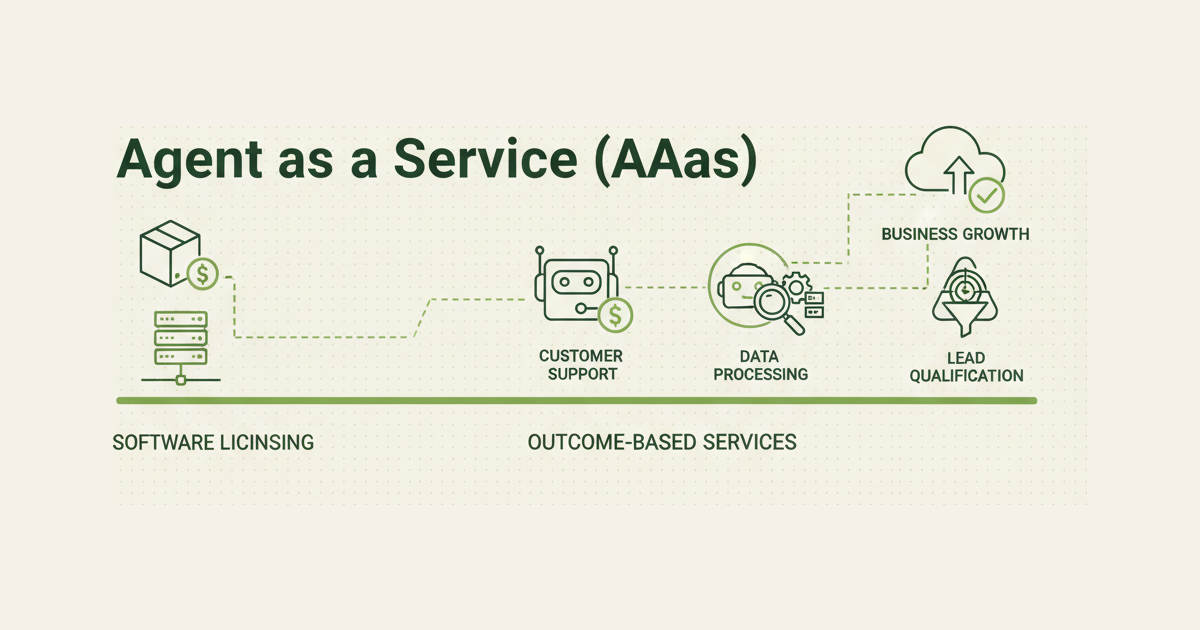
Agent as a Service (AaaS) is a cloud-based delivery model where AI agents perform specific business tasks or processes on behalf of organizations, typically charged based on outcomes, tasks completed, or usage rather than traditional subscription fees.
Unlike Software as a Service (SaaS) that provides access to applications, AaaS delivers autonomous AI agents that execute work. These agents operate independently within defined parameters, learning from interactions and improving performance over time. The fundamental difference lies in the value proposition: SaaS sells software capabilities, while AaaS sells completed work.
AaaS agents typically integrate with existing systems through APIs, webhooks, or direct database connections. They can handle everything from customer service inquiries and data processing to sales prospecting and content generation. The agents operate 24/7, scale instantly based on demand, and often achieve consistency levels that human teams struggle to maintain.
The economic model shifts risk from the buyer to the provider. Instead of paying for software that might go unused, organizations pay only when agents deliver measurable results. This outcome-based approach aligns vendor incentives with customer success, creating a more sustainable and scalable business relationship.
For SaaS founders, AaaS represents both an opportunity and a threat. It's an opportunity to reduce operational costs and improve service delivery. It's a threat because AaaS providers might eventually replace entire categories of traditional SaaS tools with autonomous agents that deliver the same outcomes more efficiently.
AaaS vs SaaS vs PaaS: The Key Differences
| Aspect | SaaS | PaaS | AaaS |
|---|---|---|---|
| What You Buy | Software access | Development platform | Completed tasks |
| Pricing Model | Per seat/month | Usage-based compute | Per outcome/task |
| Value Delivery | Tools and features | Infrastructure and APIs | Autonomous work execution |
| Implementation | User training required | Development needed | Plug-and-play agents |
| Scalability | Linear with users | Elastic with demand | Instant with task volume |
| Typical Cost Range | $10-$200/user/month | $0.01-$1.00/compute hour | $0.10-$500/task completed |
| Control Level | High user control | Full development control | Outcome-focused control |
| Maintenance | Vendor-managed | Shared responsibility | Fully vendor-managed |
The pricing implications are significant. A traditional customer support SaaS might cost $100/month per agent, regardless of ticket volume. An AaaS alternative might charge $1.50 per ticket resolved, making it cheaper for low-volume scenarios but potentially more expensive at scale.
However, AaaS pricing often includes performance guarantees that SaaS cannot match. If an AaaS agent fails to resolve a ticket within SLA parameters, you typically don't pay. This shifts operational risk from your team to the provider, potentially improving your own customer satisfaction metrics.
How AaaS Pricing Works
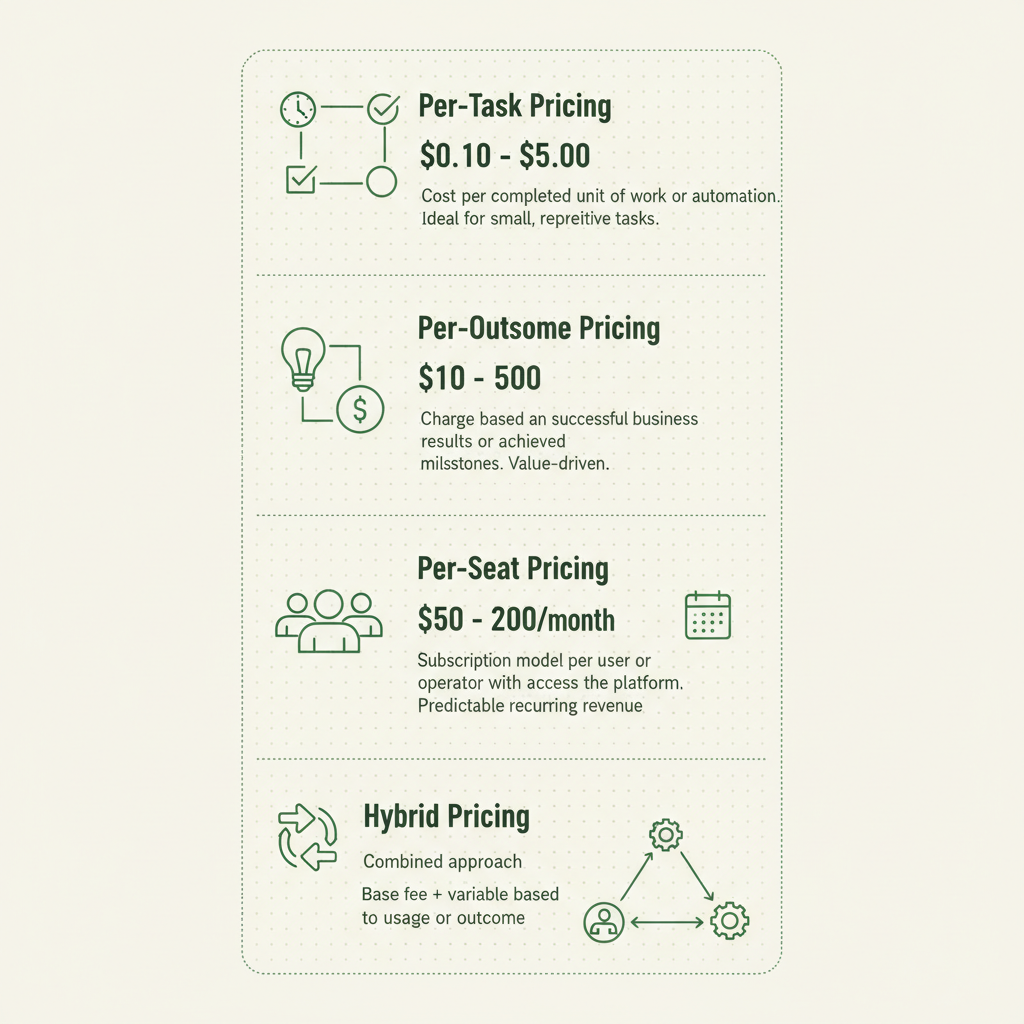
Compare AaaS pricing models to find the best fit for your business needs and usage patterns
AaaS pricing models reflect the shift from access-based to outcome-based value delivery. Understanding these models is crucial for accurate cost forecasting and vendor comparison.
Per-Task Pricing charges for individual completed actions. Customer service agents might cost $0.75 per ticket resolved, while data entry agents charge $0.05 per record processed. This model offers predictable unit economics but requires careful task definition to avoid scope creep.
Per-Outcome Pricing focuses on business results rather than individual tasks. A lead qualification agent might charge $15 per qualified lead delivered, regardless of how many touchpoints were required. This model aligns closely with business value but can be harder to predict and budget.
Per-Seat Pricing mirrors traditional SaaS but typically includes task completion guarantees. You might pay $150/month for a customer service agent that handles unlimited tickets within defined parameters. This hybrid approach offers budget predictability while maintaining outcome focus.
Hybrid Pricing combines multiple models based on usage patterns. A base monthly fee might cover setup and maintenance, with additional per-task charges for volume above certain thresholds. This approach balances predictability with scalability.
The key difference from traditional SaaS is performance accountability. AaaS providers typically offer SLAs around task completion rates, accuracy metrics, and response times. If agents fail to meet these standards, pricing adjustments or credits usually apply.
We recommend starting with per-task pricing for initial pilots, as it provides the clearest cost-benefit analysis. Once you understand usage patterns and value delivery, hybrid models often offer better long-term economics.
When AaaS Makes Sense vs Building In-House
The build vs buy decision for AI agents involves different considerations than traditional software procurement. Here's our decision matrix:
| Factor | Choose AaaS When | Build In-House When |
|---|---|---|
| Task Standardization | Highly standardized processes | Unique, proprietary workflows |
| Volume Predictability | Variable or seasonal demand | Consistent, high-volume needs |
| Time to Market | Need immediate deployment | Can invest 6-12 months development |
| Technical Expertise | Limited AI/ML team capacity | Strong internal AI capabilities |
| Integration Complexity | Standard API integrations | Deep system customization required |
| Compliance Requirements | Standard data handling | Strict regulatory or security needs |
| Budget Structure | Prefer operational expenses | Can invest in capital development |
| Risk Tolerance | Want vendor accountability | Prefer internal control |
AaaS makes sense when you need to automate standardized processes quickly without significant upfront investment. Customer support, data entry, lead qualification, and content moderation are ideal use cases. The variable cost structure works well for seasonal businesses or those testing automation before scaling.
Building in-house makes sense when your processes are highly differentiated, you have strong technical capabilities, or you need deep integration with proprietary systems. The upfront investment pays off when you have consistent, high-volume needs and want complete control over the agent's behavior.
Consider a hybrid approach for complex scenarios. Use AaaS for standardized components while building custom agents for unique workflows. This reduces development time while maintaining differentiation where it matters most.
Real-World AaaS Examples
| Provider | Service Type | Pricing Model | Use Case | Typical ROI |
|---|---|---|---|---|
| Intercom Resolution Bot | Customer Support | $0.99/resolution | Automated ticket handling | 60% cost reduction |
| Clay.com | Lead Research | $0.50-$2.00/lead | Sales prospecting automation | 300% productivity increase |
| Zapier Central | Workflow Automation | $20/month + $0.10/task | Cross-platform task execution | 40% time savings |
| Typeface | Content Generation | $0.05-$0.50/asset | Marketing content creation | 70% faster content production |
| Harvey AI | Legal Research | $50-$200/research task | Document analysis and drafting | 80% time reduction |
| Avanade Copilot | Code Review | $5-$25/review | Automated code quality checks | 50% faster deployment |
These examples demonstrate AaaS across different business functions and pricing structures. The ROI figures come from vendor case studies and should be validated for your specific use case.
Notice how pricing correlates with task complexity and business value. Simple data processing tasks cost pennies, while specialized professional services command premium pricing. This reflects the underlying AI model costs and the value delivered to end users.
Common Pitfalls When Buying AaaS
Myth: "AaaS agents work perfectly out of the box"
Reality: Most AaaS implementations require 2-4 weeks of configuration, training data preparation, and integration testing. Budget for this setup time and involve your technical team early.
Myth: "Per-task pricing is always cheaper than SaaS subscriptions"
Reality: At high volumes, traditional SaaS often becomes more cost-effective. Calculate your break-even point before committing to long-term AaaS contracts. A customer service team handling 10,000+ tickets monthly might find traditional helpdesk software cheaper than $1.50/ticket AaaS pricing.
Myth: "AaaS providers handle all compliance and security automatically"
Reality: You remain responsible for data governance, privacy compliance, and audit trails. Ensure AaaS providers meet your security standards and provide necessary compliance documentation. GDPR, HIPAA, and SOC 2 requirements don't disappear with AaaS adoption.
The biggest pitfall we see is treating AaaS like traditional software procurement. These are service relationships, not software licenses. Success requires ongoing collaboration, performance monitoring, and continuous optimization. Approach AaaS partnerships like you would outsourcing relationships, not software purchases.
How to Evaluate an AaaS Provider
We've developed the 4-O AaaS Buying Checklist to help founders make informed provider decisions:
1. Outcomes: Define measurable success criteria before evaluating providers. What specific tasks need completion? What accuracy rates are acceptable? What response times do you require? Providers should offer clear SLAs around these metrics, not just uptime guarantees.
2. Observability: Demand transparency into agent performance, decision-making processes, and failure modes. You should have real-time dashboards showing task completion rates, error types, and performance trends. Black-box agents create accountability gaps that hurt your business.
3. Ownership: Clarify data ownership, model training rights, and intellectual property boundaries. Who owns the conversation logs? Can the provider use your data to improve services for competitors? What happens to your customizations if you leave?
4. Off-ramp: Plan your exit strategy before signing contracts. How do you export data? What's the transition timeline? Are there penalties for early termination? The best AaaS providers make switching costs transparent and reasonable.
Additional evaluation criteria include:
Integration capabilities: Test API reliability, webhook consistency, and error handling. Poor integrations create more problems than they solve.
Scalability testing: Validate performance under your peak load scenarios. Many AaaS providers struggle with sudden volume spikes.
Support quality: Evaluate technical support responsiveness and expertise. You're outsourcing critical business processes — support quality matters more than traditional software.
At Ideople, we help SaaS founders navigate these evaluation criteria and implement AaaS solutions that align with their business objectives. [Schedule a consultation](https://ideople.com/demo) to discuss your specific AaaS requirements and evaluation process.
Frequently Asked Questions
What's the difference between AaaS and traditional SaaS?
AaaS delivers completed work through autonomous AI agents, while SaaS provides software tools that humans use to complete work. You pay AaaS providers for outcomes (tickets resolved, leads qualified, documents processed), whereas SaaS charges for access to features and functionality. AaaS shifts operational risk to the vendor, while SaaS keeps execution risk with your team.
How much does Agent as a Service typically cost?
AaaS pricing varies dramatically by task complexity and business value. Simple data processing tasks cost $0.05-$0.50 per action, customer service resolutions range from $0.75-$3.00 per ticket, and specialized professional services can cost $50-$500 per outcome. Volume discounts and hybrid pricing models often reduce effective costs by 20-40% compared to published rates.
Can AaaS agents integrate with existing SaaS tools?
Most enterprise AaaS providers offer pre-built integrations with popular SaaS platforms like Salesforce, HubSpot, Zendesk, and Slack. Custom integrations typically require API development work, which providers either include in setup fees or charge separately. Integration complexity directly impacts implementation timelines and ongoing maintenance requirements.
What happens if an AaaS provider goes out of business?
Provider failure risk is real and should be evaluated during vendor selection. Look for providers with strong financial backing, diversified customer bases, and clear data portability policies. Establish data backup procedures and maintain documentation of agent configurations. Consider working with providers that offer source code escrow or transition assistance guarantees.
How do you measure ROI for AaaS investments?
Calculate ROI by comparing total AaaS costs (including setup and management time) against the fully-loaded cost of human resources performing the same tasks. Include productivity gains, error reduction, and scalability benefits in your analysis. Most organizations see positive ROI within 3-6 months for standardized processes, though complex implementations may take 12+ months to break even.
What are the biggest risks with AaaS adoption?
The primary risks include vendor dependency, data security concerns, integration failures, and performance degradation over time. Mitigate these risks through careful vendor evaluation, robust SLAs, data backup procedures, and performance monitoring systems. Start with non-critical processes to build confidence before automating mission-critical workflows.
How long does AaaS implementation typically take?
Simple AaaS deployments (like chatbots or data entry agents) can be operational within 1-2 weeks. Complex implementations involving multiple systems, custom workflows, or specialized training data typically require 4-8 weeks. Enterprise deployments with extensive compliance requirements may take 3-6 months. Factor in additional time for team training and process optimization.
Can AaaS replace human employees entirely?
AaaS works best as human augmentation rather than replacement. Agents excel at repetitive, rule-based tasks but struggle with complex problem-solving, emotional intelligence, and creative work. Most successful implementations use AaaS to handle routine work while humans focus on high-value activities. Plan for workforce evolution, not elimination, when implementing AaaS solutions.
Rubal Gulati
Written by Rubal Gulati at Ideople. We build and run AI agents for our own business, then share what we learn.
Enjoyed this article?
Get AI automation insights delivered to your inbox. Start building with Ideople for free.
Get Started Free