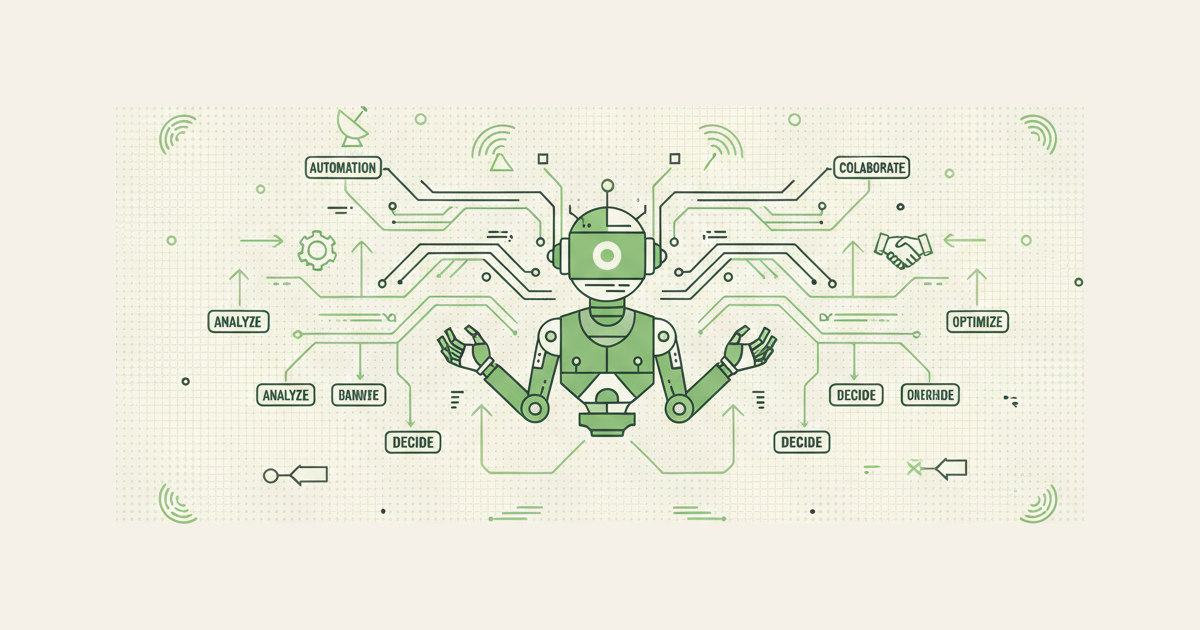
Visual representation of an intelligent agent perceiving, processing, and acting in its environment
What Is an Intelligent Agent in AI?
An intelligent agent in AI is a software system that perceives its environment through sensors, processes that information, makes autonomous decisions, and takes actions through actuators to achieve specific goals or objectives.
Think of it like a skilled chess player. Before making a move, they observe the current board state (perception), consider possible outcomes (processing), choose the best strategy (decision-making), and execute their move (action). The key difference? An intelligent agent does this continuously and autonomously, without human intervention for each decision.
Here's what makes an agent truly "intelligent" in the AI context:
Perception: It gathers information from its environment through various inputs—sensors, data feeds, user interactions, or system states.
Reasoning: It processes this information using algorithms, rules, or machine learning models to understand the current situation and predict outcomes.
Decision-Making: It evaluates possible actions against its goals and constraints, selecting the most appropriate response.
Action: It executes decisions through outputs that affect its environment—sending messages, controlling devices, updating databases, or triggering other systems.
Goal-Oriented Behavior: Everything it does serves specific objectives, whether that's maximizing user satisfaction, minimizing costs, or achieving performance targets.
The "intelligent" part comes from its ability to adapt its behavior based on changing conditions, learn from experience (in advanced systems), and make rational decisions that move it closer to its goals—even in uncertain or dynamic environments.
Intelligent Agent vs AI Agent vs Bot: What's the Difference?
We often see these terms used interchangeably, but they represent different levels of sophistication and capability. Here's how they actually compare:
| Aspect | Bot | AI Agent | Intelligent Agent |
|---|---|---|---|
| Decision Making | Rule-based, scripted responses | Uses AI/ML for decisions, but may be narrow | Autonomous, rational decision-making across domains |
| Learning Capability | No learning, fixed responses | May learn within specific tasks | Learns and adapts behavior over time |
| Environment Awareness | Limited to programmed scenarios | Aware within specific contexts | Comprehensive environmental perception |
| Goal Orientation | Task-specific, reactive | Goal-oriented within domain | Multi-goal optimization and prioritization |
| Adaptability | Requires manual updates | Adapts within trained parameters | Adapts to new situations autonomously |
| Examples | Chatbots, web scrapers | Recommendation engines, voice assistants | Autonomous vehicles, game-playing AI |
The key insight: All intelligent agents are AI agents, but not all AI agents are intelligent agents. And most bots aren't either—they're just automated tools following predetermined scripts.
The 4 Core Properties of an Intelligent Agent
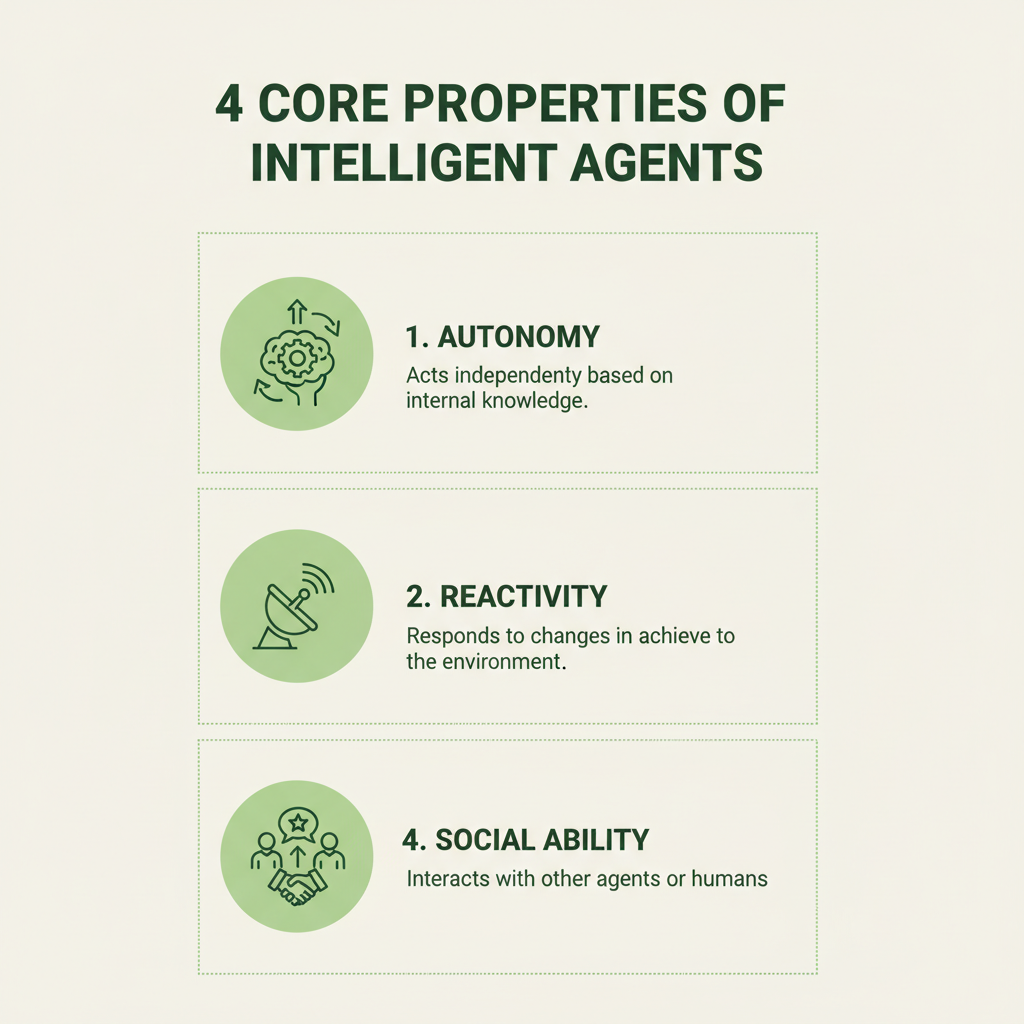
The four fundamental properties that define intelligent behavior in AI systems.
Every true intelligent agent exhibits four fundamental properties. Think of these as the "DNA" of intelligent behavior:
1. Autonomy
The agent operates independently without constant human supervision. Like a thermostat that adjusts temperature based on readings, an intelligent agent makes decisions and takes actions on its own.
Real-world example: Netflix's recommendation system autonomously analyzes your viewing patterns, compares them with similar users, and decides which shows to suggest—all without human intervention for each recommendation.
2. Reactivity
The agent perceives its environment and responds to changes in a timely manner. It's like a skilled driver who immediately adjusts when traffic conditions change.
Real-world example: Fraud detection systems in banking react instantly to unusual transaction patterns, flagging or blocking suspicious activities within milliseconds of detection.
3. Proactivity
Rather than just reacting, the agent takes initiative to achieve its goals. It's the difference between a security guard who only responds to alarms versus one who actively patrols and prevents issues.
Real-world example: Smart home systems don't just respond to your commands—they proactively adjust lighting, temperature, and security settings based on your routines and preferences.
4. Social Ability
The agent can interact and communicate with other agents, systems, or humans to achieve its objectives. Think of it as the ability to "play well with others" in a digital ecosystem.
Real-world example: In supply chain management, intelligent agents from different companies communicate to coordinate deliveries, share inventory data, and optimize logistics across multiple organizations.
5 Types of Intelligent Agents Explained
Intelligent agents exist on a spectrum of sophistication. Here are the five main types, from simplest to most advanced:
1. Simple Reflex Agents
These agents respond directly to current perceptions using condition-action rules. They're like a smoke detector—when smoke is detected, the alarm sounds.
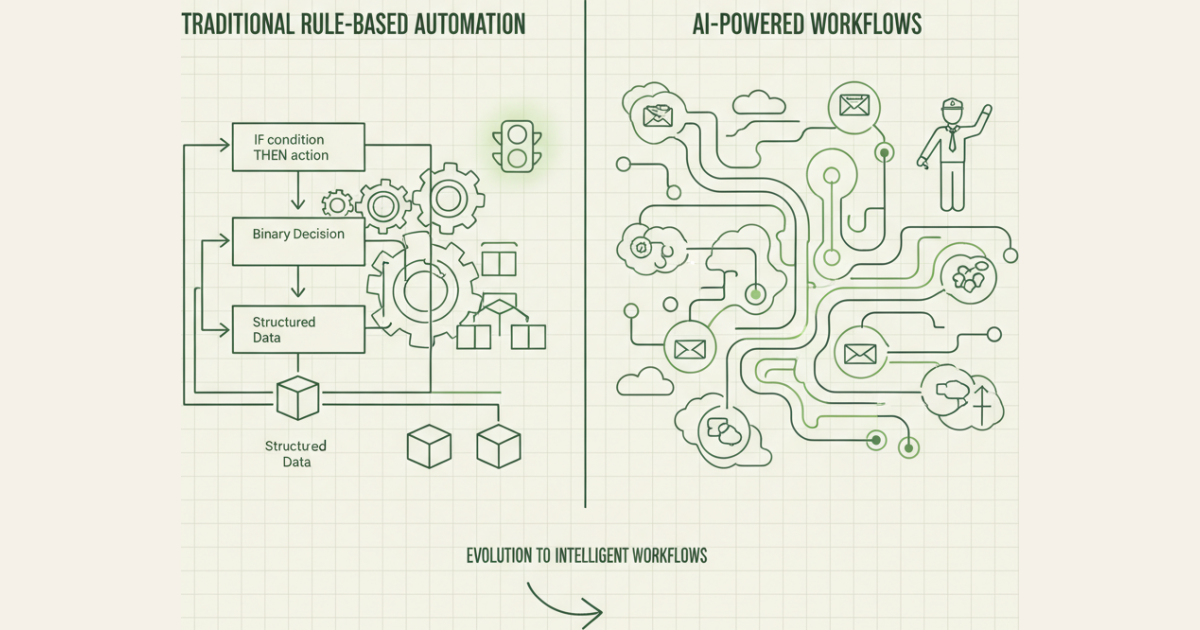
How they work: If [condition] then [action]
Limitation: No memory of past events, can't handle complex scenarios
Example: Basic chatbots that respond to specific keywords
2. Model-Based Reflex Agents
These agents maintain an internal model of their environment, allowing them to handle partially observable situations. Think of a GPS that remembers your route even when signal is temporarily lost.
How they work: Combines current perception with internal world model
Advantage: Can make decisions with incomplete information
Example: Robotic vacuum cleaners that map your home layout
3. Goal-Based Agents
These agents work toward specific objectives, evaluating actions based on whether they help achieve goals. Like a chess program that evaluates moves based on winning probability.
How they work: Considers future consequences of actions
Advantage: Can plan and make strategic decisions
Example: Route planning systems that optimize for fastest arrival time
4. Utility-Based Agents
These agents optimize for the best possible outcome when multiple goals conflict. Think of a portfolio management system balancing risk versus return.
How they work: Uses utility functions to measure "happiness" or success
Advantage: Handles trade-offs and competing objectives
Example: Dynamic pricing systems that balance profit margins with market demand
5. Learning Agents
The most sophisticated type—these agents improve their performance over time through experience. Like a human expert who gets better with practice.
How they work: Combines any of the above with learning mechanisms
Advantage: Continuously improves and adapts to new situations
Example: AlphaGo, which learned to play Go better than human champions
Real-World Examples of Intelligent Agents
Here are five concrete examples of intelligent agents you might encounter in business contexts:
| Agent Type | Industry | How It Works | Business Impact |
|---|---|---|---|
| Autonomous Trading Systems | Finance | Analyzes market data, executes trades based on algorithms, adapts to market conditions | Processes millions of transactions daily, reduces human error, operates 24/7 |
| Smart Manufacturing Controllers | Manufacturing | Monitors production lines, adjusts parameters for quality, predicts maintenance needs | Reduces downtime by 20-30%, improves product quality, optimizes resource usage |
| Personalization Engines | E-commerce | Tracks user behavior, predicts preferences, customizes product recommendations | Increases conversion rates by 15-25%, improves customer satisfaction |
| Intelligent Routing Systems | Logistics | Analyzes traffic patterns, weather, delivery constraints to optimize routes | Reduces fuel costs by 10-15%, improves delivery times, enhances customer experience |
| Cybersecurity Agents | IT Security | Monitors network traffic, detects anomalies, responds to threats automatically | Reduces response time from hours to seconds, prevents data breaches, learns new attack patterns |
Common Misconceptions About Intelligent Agents
Let's clear up three persistent myths that confuse many business leaders:
Myth 1: "All AI is intelligent agents"
Reality: Most AI tools are narrow, single-purpose systems. An image recognition API isn't an intelligent agent—it's a specialized tool. Intelligent agents combine multiple AI capabilities with autonomous decision-making and goal-oriented behavior.
Myth 2: "Intelligent agents will replace all human workers"
Reality: Intelligent agents excel at specific, well-defined tasks but struggle with creativity, emotional intelligence, and complex problem-solving that requires human judgment. They're better viewed as powerful assistants that augment human capabilities.
Myth 3: "More complex always means more intelligent"
Reality: The "intelligence" of an agent depends on how well it achieves its goals, not its technical complexity. A simple thermostat can be more "intelligent" for temperature control than a complex system that fails to maintain comfort.
How to Identify a True Intelligent Agent: The PEAS+L Test
We've developed a practical framework to help you evaluate whether a system qualifies as an intelligent agent. We call it the PEAS+L Test:
P - Performance Measure
Question: Does the system have clear, measurable objectives?
Look for: Specific metrics it's trying to optimize (accuracy, speed, cost reduction, user satisfaction)
E - Environment
Question: Can it perceive and operate in a defined environment?
Look for: Sensors, data inputs, ability to understand context and changes
A - Actuators
Question: Can it take actions that affect its environment?
Look for: Outputs, controls, ability to execute decisions and create change
S - Sensors
Question: How does it gather information about its environment?
Look for: Data collection mechanisms, monitoring capabilities, input processing
L - Learning (Our Addition)
Question: Does it improve performance over time?
Look for: Adaptation mechanisms, feedback loops, performance improvement evidence
Scoring: If a system scores "yes" on P, E, A, and S, it's likely an intelligent agent. If it also scores "yes" on L, it's a learning intelligent agent—the most sophisticated type.
Example Application:
- Spotify's recommendation system: ✓ Performance (engagement metrics), ✓ Environment (user listening data), ✓ Actuators (playlist generation), ✓ Sensors (play history, skips, likes), ✓ Learning (improves recommendations over time)
- Basic chatbot: ✓ Performance (response accuracy), ✓ Environment (text conversations), ✓ Actuators (text responses), ✓ Sensors (user messages), ✗ Learning (fixed responses)
Frequently Asked Questions
What makes an agent 'intelligent' versus just automated?
Intelligence in AI agents comes from their ability to make rational decisions in uncertain environments, adapt to changing conditions, and work toward goals autonomously. Automation simply follows predetermined rules. An intelligent agent can handle situations it wasn't explicitly programmed for by reasoning about the best course of action, while automated systems fail when they encounter unexpected scenarios.
Can intelligent agents learn from their mistakes?
Yes, learning agents—the most advanced type of intelligent agents—continuously improve their performance based on feedback and experience. They use techniques like reinforcement learning to understand which actions lead to better outcomes and adjust their behavior accordingly. However, not all intelligent agents have learning capabilities; some operate effectively using fixed algorithms and decision rules.
Do intelligent agents need machine learning to be intelligent?
No, machine learning is just one approach to creating intelligent behavior. Many effective intelligent agents use rule-based systems, optimization algorithms, or logical reasoning without ML. The key is autonomous decision-making that achieves goals effectively. However, ML does enable more sophisticated adaptation and learning capabilities that can make agents more robust in complex, changing environments.
What's the difference between reactive and proactive agents?
Reactive agents respond to environmental changes as they occur—like a thermostat that turns on heating when temperature drops. Proactive agents take initiative to achieve goals before problems arise—like a smart home system that preheats your house before you arrive home. Most sophisticated intelligent agents combine both reactive and proactive behaviors depending on the situation.
Are chatbots considered intelligent agents?
It depends on the chatbot's capabilities. Basic chatbots that follow scripted responses aren't intelligent agents—they're just automated response systems. However, advanced conversational AI that can understand context, maintain conversation state, learn from interactions, and work toward goals (like resolving customer issues) can qualify as intelligent agents using our PEAS+L framework.
How do intelligent agents make decisions?
Intelligent agents use various decision-making approaches depending on their design: rule-based systems use if-then logic, optimization algorithms find the best solution among alternatives, machine learning models predict outcomes and choose actions, and utility-based systems weigh trade-offs between competing objectives. The key is that decisions are made autonomously based on the agent's goals and environmental conditions.
What industries use intelligent agents the most?
Financial services lead in adoption with trading algorithms and fraud detection systems. Manufacturing uses intelligent agents for quality control and predictive maintenance. E-commerce relies heavily on recommendation engines and dynamic pricing. Transportation and logistics use route optimization and autonomous vehicle systems. Healthcare increasingly uses diagnostic assistance and treatment planning agents. The common thread is industries with complex, data-rich environments where autonomous decision-making provides competitive advantages.
Can multiple intelligent agents work together?
Absolutely—this is called multi-agent systems (MAS). Agents can cooperate to achieve shared goals, compete for resources, or negotiate to resolve conflicts. Examples include supply chain coordination where agents from different companies share information, smart grid systems where agents balance energy supply and demand, and autonomous vehicle networks that coordinate traffic flow. The social ability property of intelligent agents enables this collaboration.
Understanding intelligent agents isn't just academic—it's becoming essential for business leaders navigating AI adoption. These systems represent a significant evolution from simple automation to truly autonomous decision-making tools.
The key takeaway? Not all AI is created equal. When evaluating AI solutions for your business, use our PEAS+L framework to identify true intelligent agents that can adapt, learn, and deliver sustained value.
For more insights on implementing AI agents in your business strategy, explore our comprehensive guide on [AI agents for business leaders](https://ideople.com/blog/technology/what-is-an-ai-agent-the-complete-2026-guide-for-business-leaders).
Ready to stay ahead of AI developments? Subscribe to our newsletter for practical AI insights delivered to your inbox.
Rubal Gulati
Written by Rubal Gulati at Ideople. We build and run AI agents for our own business, then share what we learn.
Enjoyed this article?
Get AI automation insights delivered to your inbox. Start building with Ideople for free.
Get Started Free