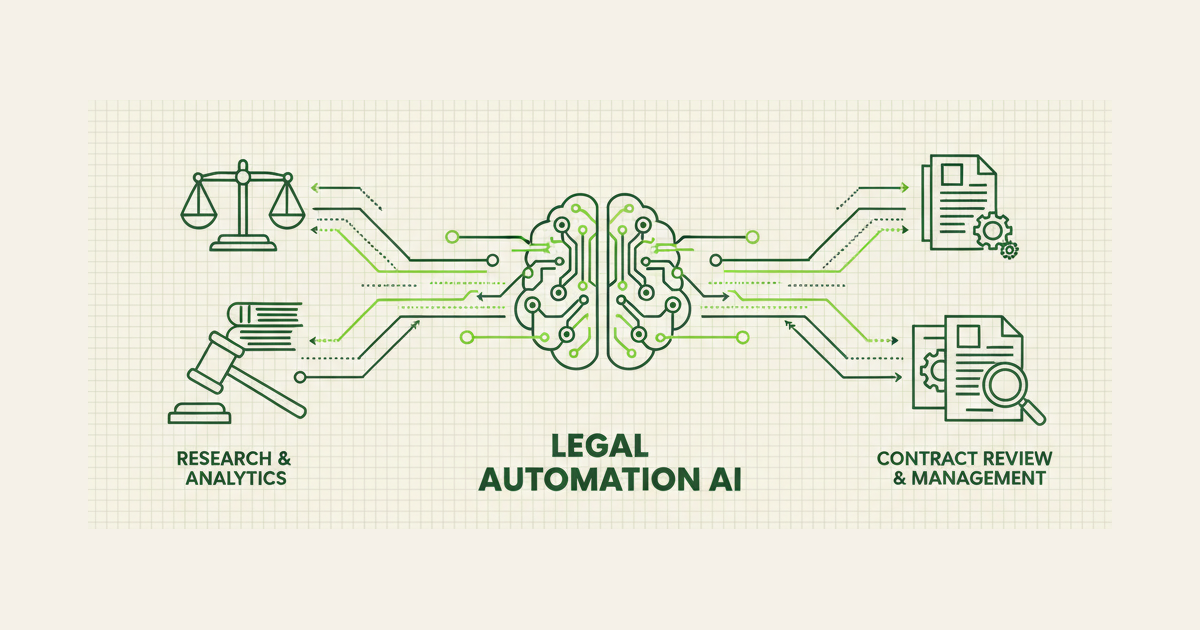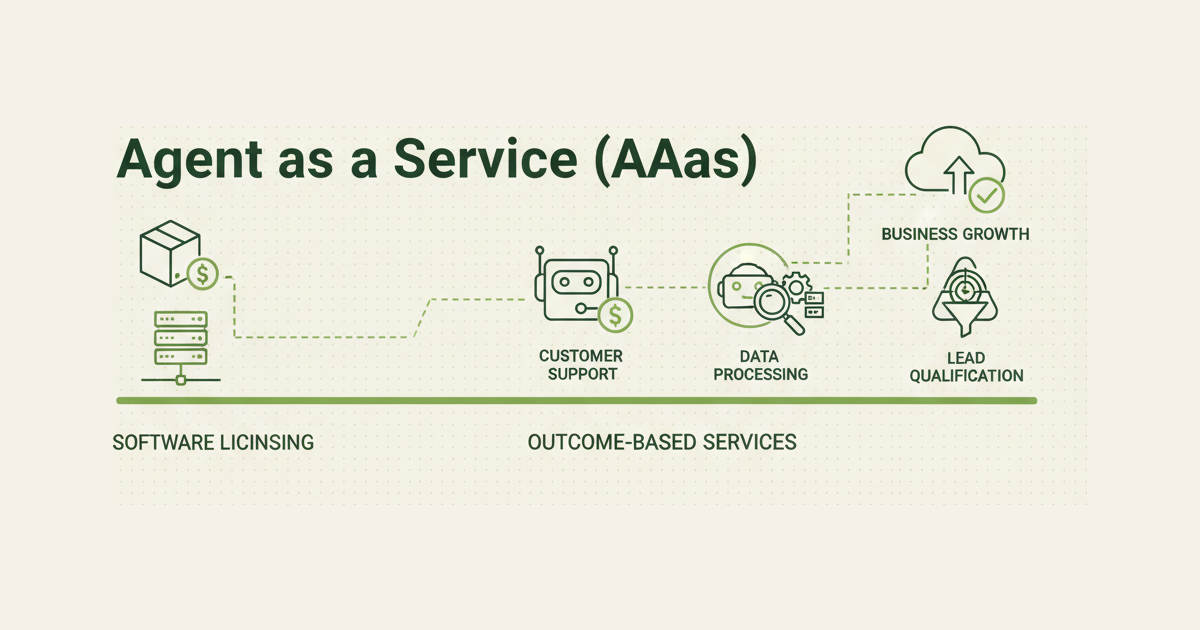
AI agents represent the next evolution in business automation, combining perception, cognition, and autonomous action capabilities
What Is an AI Agent?
An AI agent is an autonomous software system that can perceive its environment, process information, make decisions, and take actions to achieve specific objectives without requiring constant human guidance. Unlike traditional software that follows pre-programmed rules, AI agents use machine learning and reasoning capabilities to adapt their behavior based on changing conditions and learn from their experiences.
Think of an AI agent as a digital employee with specialized skills. Just as you might hire a marketing coordinator who can independently research competitors, create content calendars, and schedule social media posts, an AI agent can be designed to handle similar tasks autonomously. The key difference is that AI agents operate 24/7, process information at superhuman speeds, and can handle multiple complex tasks simultaneously.
AI agents combine three core capabilities: perception (gathering and interpreting data from various sources), cognition (reasoning about that data to make informed decisions), and action (executing tasks or communicating results). This combination allows them to operate independently while still working toward business objectives you define.
The technology builds on advances in large language models, computer vision, and reinforcement learning to create systems that can understand context, maintain memory of past interactions, and improve their performance over time. For business leaders, this means AI agents can handle increasingly sophisticated workflows that previously required human judgment and decision-making.
Why AI Agents Matter More Than Ever in 2026
The timing for AI agent adoption has never been more critical. According to Gartner's 2024 AI Hype Cycle report, 33% of enterprise software applications will include agentic AI by 2028, representing a massive shift from traditional reactive systems to proactive digital workers. McKinsey's latest research shows that companies implementing AI agents are seeing 40% improvements in operational efficiency within the first six months of deployment.
The labor shortage crisis is driving much of this urgency. The U.S. Bureau of Labor Statistics projects 6.5 million unfilled jobs in knowledge work by 2026, while 73% of business leaders report difficulty finding qualified talent for routine analytical tasks. AI agents are filling this gap by handling repetitive workflows, data analysis, and customer interactions that would otherwise require human resources.
Perhaps most importantly, the competitive landscape is shifting rapidly. Salesforce's State of AI report reveals that 67% of IT leaders believe AI agents will become a competitive necessity rather than advantage by 2026. Companies that delay adoption risk falling behind competitors who are already leveraging autonomous systems to operate faster, more accurately, and at lower costs than traditional human-dependent processes.
How AI Agents Actually Work
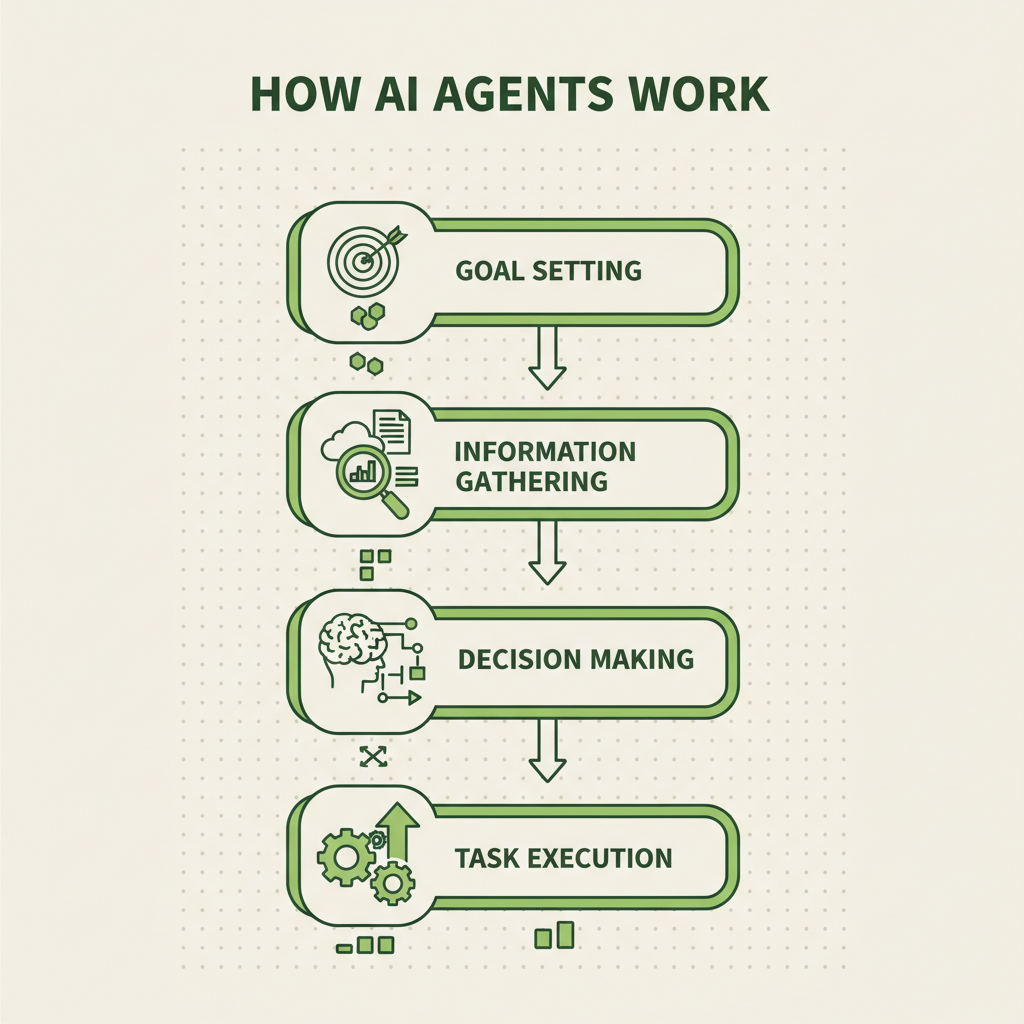
The four-stage process that AI agents follow to complete tasks autonomously, from initial goal setting through final execution.
Understanding how AI agents function is easier when you think of them as digital employees with specific job descriptions. Just as a human employee goes through a process of receiving instructions, gathering information, making decisions, and completing tasks, AI agents follow a similar workflow—but at machine speed and scale.
The process begins with goal setting, where you define what you want the agent to accomplish, similar to giving a new hire their job responsibilities. The agent then uses its perception capabilities to gather relevant information from databases, APIs, documents, or real-time data streams. This is like an employee researching background information before starting a project.
Next comes the decision-making phase, where the agent's cognitive capabilities analyze the gathered information against its training and your business rules. Think of this as an experienced employee using their knowledge and company guidelines to determine the best approach to a problem. The agent weighs different options, considers potential outcomes, and selects the most appropriate course of action.
Finally, the agent executes tasks through its action capabilities—sending emails, updating databases, generating reports, or triggering other software systems. Unlike a human employee who might handle one task at a time, an AI agent can manage dozens of parallel workflows while maintaining context and consistency across all activities.
The key difference is that AI agents can operate continuously, learn from each interaction, and scale their capabilities without the limitations of human factors like fatigue, availability, or training time.
The 5 Types of AI Agents Every Business Should Know
Reactive Agents
Reactive agents are the simplest form, responding directly to current inputs without maintaining memory of past interactions. These work well for straightforward tasks like answering FAQ questions or processing standard data entry. Think of them as digital receptionists who can handle routine inquiries but don't build relationships or learn from previous conversations.
Deliberative Agents
Deliberative agents maintain internal models of their environment and can plan sequences of actions to achieve goals. They're ideal for complex workflows like project management, where the agent needs to coordinate multiple tasks, track dependencies, and adjust plans based on changing circumstances. These agents excel in scenarios requiring strategic thinking and multi-step problem solving.
Learning Agents
Learning agents continuously improve their performance through experience, making them valuable for dynamic environments where optimal strategies evolve over time. They're particularly effective for personalization tasks, fraud detection, or any application where patterns change frequently and the agent needs to adapt its approach.
Collaborative Agents
Collaborative agents work alongside humans and other agents, sharing information and coordinating actions to achieve common objectives. These are becoming increasingly important in business environments where AI augments rather than replaces human capabilities, such as in creative workflows or complex decision-making processes.
Goal-Based Agents
Goal-based agents focus on achieving specific objectives and can evaluate different paths to determine the most effective approach. They're excellent for optimization tasks like resource allocation, scheduling, or any scenario where multiple valid solutions exist and the agent needs to select the best option based on defined criteria.
AI Agents vs Chatbots vs Traditional Automation
| Feature | Traditional Chatbots | Workflow Automation | AI Agents |
|---|---|---|---|
| Autonomy Level | Reactive responses only | Follows pre-set rules | Autonomous decision-making |
| Learning Capability | Static responses | No learning | Continuous improvement |
| Task Complexity | Simple Q&A | Single workflow execution | Multi-step complex processes |
| Context Awareness | Limited to current conversation | No context retention | Maintains long-term memory |
| Adaptability | Requires manual updates | Rigid rule-based logic | Adapts to new situations |
| Integration Scope | Usually single channel | Specific system connections | Cross-platform orchestration |
| Human Oversight | Minimal required | Periodic monitoring | Strategic guidance only |
Real-World AI Agent Use Cases for Business
| Industry | Use Case | Agent Type | Business Impact |
|---|---|---|---|
| E-commerce | Inventory management and demand forecasting | Learning Agent | 23% reduction in stockouts, 18% lower carrying costs |
| Healthcare | Patient appointment scheduling and follow-up | Collaborative Agent | 35% improvement in appointment adherence |
| Financial Services | Fraud detection and risk assessment | Deliberative Agent | 67% faster threat identification, 45% fewer false positives |
| Manufacturing | Predictive maintenance scheduling | Goal-Based Agent | 28% reduction in unplanned downtime |
| Customer Service | Multi-channel support ticket resolution | Reactive Agent | 52% faster resolution times, 89% customer satisfaction |
| Marketing | Lead qualification and nurturing campaigns | Learning Agent | 41% improvement in conversion rates |
| HR | Resume screening and interview scheduling | Deliberative Agent | 73% faster hiring process, 31% better candidate quality |
Common Misconceptions About AI Agents
Myth: AI Agents Will Replace All Human Workers
Reality: AI agents are designed to augment human capabilities, not replace them entirely. While they excel at routine, data-intensive tasks, they still require human oversight for strategic decisions, creative problem-solving, and complex relationship management. The most successful implementations combine AI efficiency with human judgment and creativity.
Myth: AI Agents Are Too Complex for Small Businesses
Reality: Modern AI agent platforms offer user-friendly interfaces and pre-built templates that make implementation accessible to businesses of all sizes. Many solutions require no coding experience and can be deployed within days rather than months. The key is starting with simple use cases and scaling gradually.
Myth: AI Agents Always Make Perfect Decisions
Reality: AI agents are probabilistic systems that make decisions based on patterns in their training data and current inputs. While they can be highly accurate, they're not infallible and require proper monitoring, testing, and human oversight to ensure optimal performance. The goal is consistent, scalable decision-making, not perfection.
How to Choose Your First AI Agent: The SCALE Framework
1. Scrutinize Your Current Workflows
Start by identifying repetitive, rule-based tasks that consume significant time but don't require creative thinking. Look for processes where human employees spend more than 20% of their time on routine activities like data entry, scheduling, or basic customer inquiries. Document these workflows in detail, including decision points, data sources, and desired outcomes.
2. Categorize by Complexity and Impact
Rank potential use cases using a simple 2x2 matrix: implementation complexity (low to high) versus business impact (low to high). Focus initially on high-impact, low-complexity opportunities that can deliver quick wins and build organizational confidence in AI agent capabilities.
3. Assess Your Data and Integration Readiness
Evaluate whether you have clean, accessible data for your chosen use case and whether your existing systems can integrate with AI agent platforms. Most successful implementations require structured data and API access to key business systems. If your data needs significant cleanup, factor this into your timeline and budget.
4. Launch with a Pilot Program
Begin with a limited scope pilot involving 1-2 team members and a single, well-defined workflow. Set clear success metrics, establish monitoring procedures, and plan for iterative improvements. This approach minimizes risk while providing valuable learning experiences for scaling to larger implementations.
5. Evaluate and Expand Strategically
After 30-60 days, assess pilot results against your success metrics and gather feedback from users. Use these insights to refine your approach before expanding to additional use cases or team members. Consider partnering with experienced AI implementation specialists like Ideople to accelerate your scaling process and avoid common pitfalls.
Frequently Asked Questions
What are the main benefits of AI agents for small businesses?
AI agents offer small businesses the ability to operate with enterprise-level efficiency without the corresponding headcount. Key benefits include 24/7 availability, consistent performance, reduced operational costs, and the ability to scale operations without proportional increases in staff. Small businesses typically see ROI within 3-6 months through reduced labor costs and improved customer response times.
How much do AI agents cost to implement?
AI agent costs vary significantly based on complexity and scale, ranging from $50-500 per month for simple automation agents to $5,000-50,000 for enterprise-level implementations. Most businesses see positive ROI within 3-6 months through reduced labor costs and improved efficiency. Consider starting with low-cost platforms like Zapier's AI features or Microsoft Power Platform before investing in custom solutions.
Can AI agents replace human employees?
AI agents are designed to augment rather than replace human workers. They excel at routine, data-intensive tasks but still require human oversight for strategic decisions, creative problem-solving, and relationship management. The most successful implementations combine AI efficiency with human judgment, allowing employees to focus on higher-value activities while agents handle repetitive workflows.
What's the difference between AI agents and RPA?
RPA follows pre-programmed rules and breaks when processes change, while AI agents can adapt to new situations and make decisions based on context. RPA is like a very fast, accurate robot following a script, whereas AI agents are more like digital employees who can think through problems and adjust their approach based on changing circumstances.
How long does it take to implement an AI agent?
Simple AI agents can be deployed in days using no-code platforms, while complex custom agents may take 2-6 months to develop and refine. The key factors affecting timeline include data preparation, system integration complexity, and the sophistication of decision-making required. Most businesses benefit from starting small and scaling gradually.
Do I need technical expertise to use AI agents?
Modern AI agent platforms are designed for business users, not just technical teams. While initial setup may benefit from technical support, day-to-day management typically involves updating business rules, monitoring performance metrics, and refining workflows—tasks that business stakeholders can handle with proper training.
What industries benefit most from AI agents?
AI agents deliver value across industries, but early adopters in customer service, financial services, healthcare, and e-commerce are seeing the strongest returns. The key is identifying repetitive, data-driven processes rather than focusing on industry-specific applications. Any business with routine workflows and structured data can benefit from AI agent implementation.
How do I measure AI agent ROI?
Focus on metrics that align with your business objectives: time savings, cost reduction, accuracy improvements, or customer satisfaction scores. Establish baseline measurements before implementation and track both quantitative metrics (processing time, error rates) and qualitative feedback (user satisfaction, process improvement suggestions) to get a complete picture of impact.
Rubal Gulati
Written by Rubal Gulati at Ideople. We build and run AI agents for our own business, then share what we learn.
Enjoyed this article?
Get AI automation insights delivered to your inbox. Start building with Ideople for free.
Get Started Free